

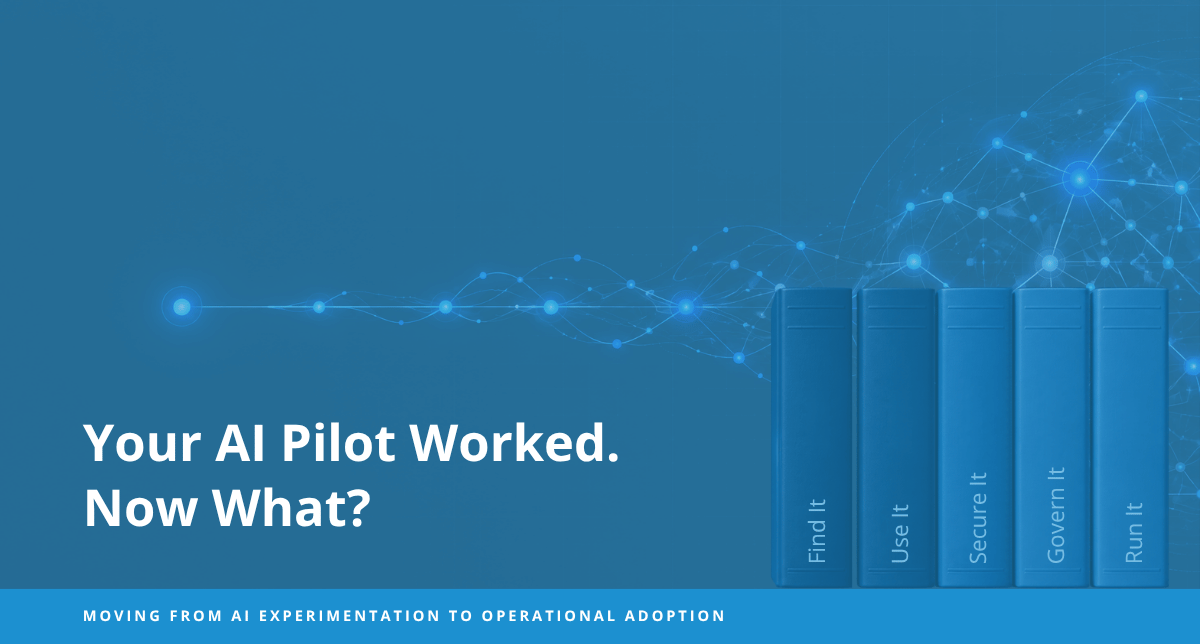
Your AI pilot worked. Now what?
Your team tested an AI tool, demonstrated its potential, and generated enthusiasm. But months later, the pilot is still limited to a handful of employees.
Leadership wants to see measurable value. IT has questions about security. Compliance needs answers about data handling. And no one is quite sure who owns the next step.
Sound familiar?
It’s a common challenge for organizations navigating AI adoption. Demonstrating what AI can do is one thing. Making it a dependable part of everyday business operations requires a different level of preparation.
Operational AI adoption starts when experimentation becomes a managed business capability, with clear ownership, repeatable workflows, appropriate safeguards, and measurable results.
At Varium, we help organizations make that transition through The Repertoire, five connected movements designed to identify opportunities, build capabilities, secure information, establish governance, and sustain AI operations.
Why Promising AI Pilots Stall
AI experimentation is relatively easy to begin. Employees can test tools, explore use cases, and demonstrate results with limited resources.
Moving those experiments into production introduces new responsibilities.
Ownership is unclear. A pilot may have an enthusiastic champion, but no accountable business owner responsible for expansion, performance, and risk.
The workflow isn’t established. A successful demonstration may depend on carefully selected examples or the knowledge of one experienced employee. Without a repeatable process, consistent execution becomes difficult.
Data security questions remain unanswered. Employees may experiment with sensitive information before the organization has established which tools, data types, and integrations are approved.
Business value hasn’t been measured. Positive feedback is encouraging, but leadership needs evidence of time saved, quality improved, costs reduced, or other meaningful outcomes.
Ongoing support is missing. AI tools and organizational needs change. Without responsibility for monitoring performance, updating policies, and supporting employees, adoption becomes difficult to sustain.
These challenges are solvable. Addressing them requires coordination across business strategy, people, processes, technology, and governance.
Five Movements from Experimentation to Adoption
Varium’s Repertoire brings these capabilities together through five connected movements.
Each addresses a different aspect of operational readiness. Organizations can begin wherever their needs are greatest, then build toward a coordinated AI program.
1. Find It: Identify Where AI Belongs
Before investing in new capabilities, understand where AI can deliver meaningful value and what might prevent successful adoption.
Varium’s Opportunity Assessment examines business processes, identifies potential use cases, and helps prioritize investments according to impact and feasibility.
Our AI Governance Readiness Assessment evaluates existing AI use, oversight, policies, and potential areas of exposure.
Together, these assessments help leadership answer three essential questions:
- Which opportunities deserve investment?
- What needs to change before deployment?
- Where should we start?
The outcome: A prioritized roadmap connecting AI opportunities with business value and organizational readiness.
2. Use It: Build Skills Around Real Work
Successful adoption depends on employees knowing how to apply AI consistently and appropriately.
Varium’s AI Enablement programs focus on practical applications within the tools and workflows employees use every day.
Instructor-led sessions combine foundational knowledge with hands-on execution, helping teams develop repeatable processes they can refine, document, and share.
The objective is to build organizational capability that extends beyond a handful of enthusiastic early adopters.
The outcome: Employees equipped to use AI confidently, supported by documented workflows and reusable practices.
3. Secure It: Protect the Information AI Touches
As AI becomes part of daily operations, organizations need clear expectations and appropriate safeguards for protecting sensitive information.
Varium combines AI security education with technical preparation for organizations working in sensitive or regulated environments.
Depending on the engagement, this may include employee training, evaluation of data pathways, infrastructure hardening, access controls, and documentation of security measures.
The right controls depend on the technology, information, and business use case involved.
The outcome: Defined data handling practices, informed employees, and security controls appropriate to the AI environment.
4. Govern It: Establish Accountability
Who approves AI use? Who owns the results? What happens when a system produces an incorrect output or a new risk emerges?
These questions need clear answers before AI becomes embedded in critical business processes.
Varium’s AI Governance services help organizations develop practical AI use policies, assign responsibilities, establish oversight, and define processes for evaluating and managing risk.
Governance should reflect how an organization actually operates, making responsible AI use easier to understand and maintain.
The outcome: Documented accountability, practical policies, and a governance structure that supports responsible adoption.
5. Run It: Sustain the Program
Deployment is a milestone. Long-term value depends on what happens afterward.
Employees need support. Workflows need monitoring. Policies need maintenance. New capabilities and risks require evaluation.
Varium’s ongoing governance and managed services help organizations maintain oversight, respond to changing requirements, and continuously improve their AI programs.
For businesses without dedicated internal AI governance resources, ongoing support can provide the continuity needed to keep initiatives moving.
The outcome: An AI program with established support, ongoing oversight, and a process for continuous improvement.
From Pilot to Practice: Six Questions Every Organization Should Answer
Before expanding an AI pilot, leadership should be able to answer six practical questions.
1. Who owns the outcome? Assign an accountable business owner responsible for the workflow, its results, and decisions about continued use.
2. Can the process be repeated? Document when and how AI is used, who reviews the output, and how the work connects to existing business systems.
3. Is the data appropriately protected? Establish which information the AI system may access, what safeguards are required, and which uses are prohibited.
4. How will success be measured? Define a baseline and track relevant outcomes such as turnaround time, quality, cost, or employee capacity.
5. Who supports the workflow after launch? Assign responsibility for employee support, performance monitoring, training updates, and policy maintenance.
6. Is there a sustainable operating budget? Account for recurring software, infrastructure, governance, support, and training costs. Determine who owns the budget and how continued investment will be evaluated.
These questions provide a practical readiness check before moving from experimentation into broader operational adoption. They also help identify which parts of The Repertoire can address the organization’s most immediate needs.
What Operational AI Adoption Looks Like
Consider a hypothetical professional services firm with 260 employees.
Eight members of its client onboarding team have spent three months testing an AI assistant that summarizes incoming client agreements. Early feedback is positive. Employees see an opportunity to reduce administrative work and accelerate onboarding.
But expansion stalls when the compliance lead asks which client information the assistant processed during testing. The team cannot provide a complete answer. The technology has demonstrated potential. The organization still needs an operating framework before expanding its use.
Here’s how the five movements could help.
Find It: Leadership evaluates the opportunity, reviews existing AI activity, and confirms that client onboarding is a worthwhile use case.
Use It: Employees receive practical training and document a consistent method for preparing, reviewing, and approving AI-generated summaries.
Secure It: The organization establishes approved data handling procedures and evaluates the technical safeguards needed for its document environment.
Govern It: An accountable business owner is assigned, acceptable uses are defined, and human review requirements are documented.
Run It: The workflow is incorporated into ongoing monitoring, employee support, policy review, and performance evaluation.
The resulting operational framework identifies:
- Workflow: Client agreement summaries for onboarding.
- Accountable owner: Director of Client Onboarding.
- Approved data: Authorized agreement content handled according to documented policies and controls.
- Performance measure: First-draft turnaround time measured against a predeployment baseline.
- Human oversight: An onboarding lead reviews and approves summaries before they enter the client file.
- Ongoing support: Periodic reviews of performance, training, policies, and security controls.
- Budget: An assigned operating budget with regular evaluation.
This example is illustrative. The organization, workflow, and outcomes are hypothetical.
The important change is operational. The firm now has a defined process for managing the workflow, evaluating its value, and making informed decisions about future expansion.
That’s what separates a promising AI experiment from an operational business capability.
Your Next AI Initiative Deserves an Operating Plan
A successful AI pilot demonstrates potential. Operational adoption turns that potential into something employees can use, leadership can measure, and the organization can manage responsibly.
It requires more than selecting the right technology.
It requires people who understand how to use it, processes that support consistent execution, security controls that protect information, governance that establishes accountability, and ongoing support that keeps the program effective.
You don’t have to solve every AI challenge across the organization at once.
Start with one promising use case. Identify what’s preventing broader adoption. Establish the ownership, safeguards, and measures needed to move it forward.
Then build on what works.
Ready to Move Beyond AI Experimentation?
At Varium, we help organizations turn promising AI initiatives into secure, measurable, and sustainable operations.
Whether you’re evaluating your first AI opportunities, expanding a successful pilot, or establishing governance across an existing program, our team can help identify the next practical step.
Your AI investment has demonstrated potential. Is your organization ready to put it to work?
Explore Varium’s AI Practice and take the next step toward operational AI adoption.
Comments are closed