
AI governance now carries financial weight. Insurers are writing AI exclusions into standard commercial policies, boards are asking how AI is controlled, and customers expect assurance. The answer is evidence of oversight.
Varium helps organizations build that evidence. We work with leadership teams to find where AI is in use, set the policies and ownership around it, and keep oversight running after launch.
Why Governance Is Now a Coverage Question
For years, AI exposure sat inside existing insurance policies without being called out. That is changing at renewal. In January 2026, the Insurance Services Office (ISO) introduced generative AI exclusion endorsements for commercial general liability forms. W.R. Berkley has filed an “absolute” AI exclusion designed to remove coverage across D&O, E&O, and fiduciary lines for claims connected to AI use.
Underwriters are also asking questions. Which AI systems are in use? What information can they reach? Who approves their deployment? How is their behavior monitored? These are the questions an insurer, a client, or an auditor may put to an organization, and the quality of the answers can influence coverage terms, pricing, and contract conditions.
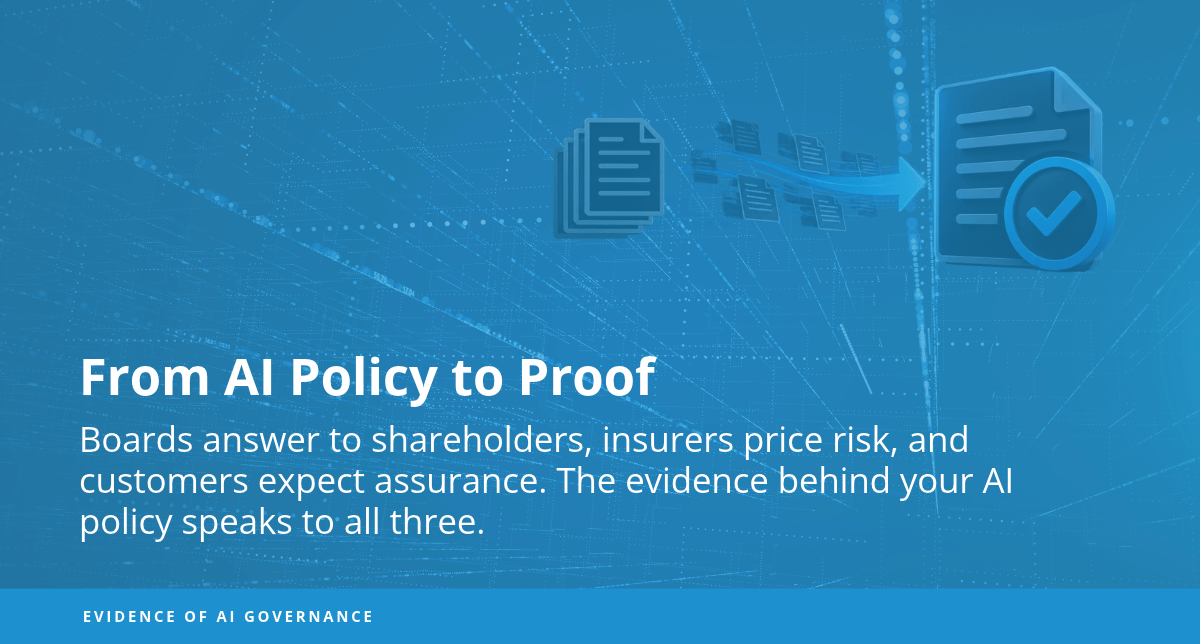
Key Takeaway: Boards answer to shareholders, insurers price risk, and customers need assurance. Organizations that can answer with documents and records are better positioned than those that can answer only with a policy.
Operationalizing Intent
Governance begins with a decision about what an organization intends its AI systems to do. That raises a question policies rarely answer: how does an AI system know what the organization intends?
Take an AI agent that helps the clinical operations team at a contract research organization review site monitoring reports. The organization may want it to find relevant information, summarize protocol deviations, and draft follow-up queries for a person to review. It does not want the agent assessing the seriousness or cause of an adverse event, disclosing participant information, carrying one sponsor’s confidential data into another sponsor’s study, or changing a trial record without approval. Those boundaries have to be translated into the system’s instructions, permissions, workflows, and controls. Then they have to be tested.
Training employees to follow an AI policy matters, but that’s only half of the work. The organization must also establish whether its AI-enabled systems operate consistently with that policy. Depending on the technology, that means configuring instructions, restricting access, defining approval requirements, evaluating outputs, and testing how the system responds to situations nobody planned for.
The Standard To Meet: Responsible AI governance is evidence that the organization understood its risks, set boundaries, tested its approach, and acted when problems appeared. A policy states intent. Evidence shows it was carried out.
What Evidence Looks Like
A company should be able to show what it expected an AI system to do, what safeguards it set, how it tested them, and what happened when the system did not behave as intended. Checklists, testing records, and documented evaluations turn governance into a repeatable process in place of assurances. In practice, that evidence can include:
- An inventory of approved AI systems and the workflows they support
- Documented risk assessments
- Data access controls
- Vendor reviews
- Employee training records
- Incident response procedures
- Records of important AI-assisted decisions
The objective is to make governance observable. When a board member, insurer, customer, or regulator asks how the organization manages AI risk, the answer should rest on more than a policy document. That matters most as AI moves out of individual productivity tools and into operational workflows that touch customers, financial transactions, and regulated information.
Governance Belongs to the Whole Organization
AI governance cannot sit with IT alone. Legal, finance, risk management, operations, and business leadership each have a role in deciding how AI is introduced and managed. Three patterns tend to expose weak governance quickly:
- Ownership: No one is accountable for approving AI systems, maintaining the policy, or monitoring use after launch.
- Shadow AI: Employees use AI tools that leadership has not inventoried or approved.
- Key-Person Dependence: Governance lives in one person’s head, so the program stops when that person is unavailable.
Five Questions to Ask Now
Organizations do not need to wait for a renewal or a new regulation to test their governance. These five questions are a practical place to begin.
- Can we name every AI tool and workflow in use, including tools employees adopted on their own?
- Do we have a current AI use policy, and does someone own it?
- Can we produce documentation of our controls and decisions quickly if an insurer, client, or auditor asks?
- Is someone accountable for approving AI systems and monitoring them after launch?
- If the person who runs AI governance leaves, does the program continue?
How Varium Helps
Varium’s AI practice moves organizations from finding their AI exposure to governing it and keeping that oversight current.
- Find It: The AI Opportunity and Governance Readiness Assessment is a fixed-scope assessment, measured in weeks. It finds where AI is used without oversight, where policy is missing, and where an auditor, regulator, or client questionnaire would find a gap.
- Govern It: AI Policy and Governance runs from a single defensible AI use policy to a full governance document suite, with implementation support.
- Run It: AI Operations and Monitoring provides ongoing monitoring, incident response, and regular review, so problems are caught by the organization and not by a customer.
Findings from the assessment become the agenda for policy work, and the policy work leads into ongoing monitoring. Varium’s Repertoire and AI governance consulting guide teams through safe AI workflows at each step.
Governance also works best alongside the right technology. Pensato supplies it: secure AI that runs a local LLM on local AI infrastructure and protects PII (Personally Identifiable Information) with secure tokens, so the workflows Varium helps design have a secure foundation.
Take The AI Governance Assessment: See where your organization stands on AI governance, which gaps to close first, and what an insurer or client would ask to see. You receive a scorecard when you finish, and Varium can walk through the results with you.
- Take the assessment: AI Governance Assessment (free)
- Put the controls in place with Pensato’s secure AI
Sources
- Insurance Business, “Why your clients probably aren’t covered for AI”
- Shumaker, Loop and Kendrick, “The New AI Coverage Fight”
Comments are closed