
AI governance is a business-wide responsibility that requires clear ownership, practical policies, and ongoing oversight. It starts with leadership.
AI is becoming part of everyday business operations. Teams are using it to draft documents, analyze information, streamline workflows, and make decisions faster.
As adoption expands, an important question often goes unanswered:
Who is actually accountable for how AI is used across the organization?
IT may manage the technology. Legal may evaluate compliance requirements. Department leaders may introduce new tools. Employees may already be experimenting with AI without formal approval.
Each group plays a role, but when nobody has clear ownership, decisions become fragmented. Tools are adopted without consistent evaluation, sensitive information may be exposed, and organizations struggle to explain how AI-related risks are being managed.
That’s where AI governance comes in.
AI Governance Is a Leadership Responsibility
AI governance establishes the policies, responsibilities, and oversight needed to use artificial intelligence responsibly. It defines which tools are approved, what information they can access, how risks are evaluated, who is accountable for outcomes, and how AI activity is monitored.
While IT and security teams are essential to implementation, business leadership must set the direction.
Executives determine how AI supports organizational goals, establish acceptable risk levels, approve governance policies, and assign responsibility for decisions.
IT, security, legal, compliance, and operational teams then help translate those expectations into working processes and safeguards. The goal is to make AI adoption more deliberate, accountable, and sustainable.
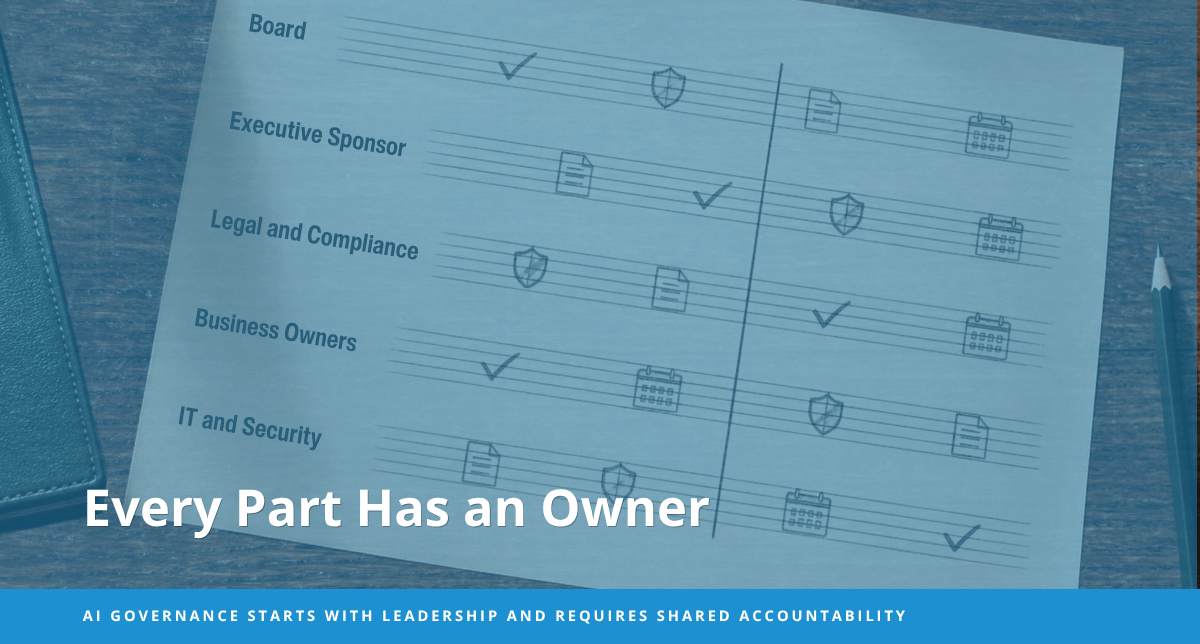
Who Is Responsible for AI Governance?
Effective AI governance involves multiple functions, each with distinct responsibilities.
Board of Directors or Business Owners
Provide oversight of significant AI-related risks and ensure that AI strategy supports the organization’s broader business objectives. They should receive appropriate reporting on material risks, investments, and outcomes.
Executive Leadership
Establish AI priorities, approve policies, define risk tolerance, and assign accountability. Leadership is responsible for ensuring governance has the resources and authority to operate effectively.
Legal and Compliance
Evaluate applicable regulatory requirements, privacy obligations, contractual commitments, and potential legal exposure associated with AI use.
Business Unit Leaders
Own the business outcomes and operational risks associated with AI use cases within their departments. They help determine where AI adds value and ensure appropriate human oversight.
IT and Security
Evaluate technical environments, manage access, implement data protection controls, assess technical risks, and monitor approved AI systems.
Employees
Follow approved AI use policies, handle information appropriately, review AI-generated outputs as required, and report potential concerns.
In smaller organizations, one person may fulfill several of these responsibilities. Larger enterprises may establish a dedicated AI governance committee or appoint a Chief AI Officer to coordinate strategy and oversight.
The structure can vary. What matters is that decisions have clear owners and accountability is understood across the organization. Shared responsibility works when ownership is explicit.
Five Essentials of a Practical AI Governance Program
Organizations don’t need an elaborate governance structure to get started. They need a foundation that reflects how AI is actually being used.
1. Know Where AI Is Being Used
Start with an inventory of AI tools and use cases across the organization.
Identify who is using each tool, what information it processes, which business workflows it supports, and who is responsible for its operation. Include AI capabilities embedded within existing software, not just standalone AI applications.
Without visibility into current use, it’s difficult to evaluate exposure or establish meaningful oversight.
2. Understand the Risks
AI applications carry different levels of risk depending on their purpose, the information involved, and the potential consequences of errors.
Using AI to brainstorm internal communications presents different considerations than processing customer financial records, analyzing confidential legal documents, or supporting decisions that affect individuals. Evaluate use cases according to their business impact, data sensitivity, applicable obligations, and the level of human oversight required.
This helps organizations apply appropriate safeguards without creating unnecessary barriers to lower-risk uses.
3. Establish a Clear AI Use Policy
Employees need practical guidance they can apply to everyday work.
An effective AI use policy should explain which tools are approved, what information may be entered, which activities require additional authorization, and how employees should handle AI-generated outputs. It should also establish a clear process for requesting approval of new tools or use cases.
A policy is most valuable when people understand it and can follow it.
4. Train Your People
AI governance depends on employee awareness and participation.
Foundational training should help employees understand approved uses, data handling expectations, the limitations of AI-generated content, and when human review is necessary. Teams working with sensitive information or higher-risk workflows may require additional, role-specific training.
Training should evolve as tools, policies, and business processes change.
5. Review, Monitor, and Adapt
AI governance is an ongoing operational responsibility.
Organizations should establish a regular process for reviewing AI use cases, evaluating incidents, monitoring vendor changes, and updating policies. Assign owners, define reporting expectations, and ensure that significant issues can be escalated to the appropriate decision-makers.
These five practices create a foundation that can grow with the organization.
What Does AI Governance Look Like in Practice?
Consider an insurance brokerage that wants to use AI to help draft client proposals. The business sees an opportunity to reduce administrative work and improve turnaround times. But the proposals may contain client names, coverage details, financial information, and other sensitive records.
Before approving the workflow, several groups need to contribute.
Business leadership determines whether the use case supports organizational priorities and who will be accountable for proposal accuracy and client outcomes.
Legal and compliance reviews privacy, regulatory, and contractual requirements that may affect how information can be processed.
IT and security evaluates the proposed AI tool, its data handling practices, access controls, and available protections.
Employees receive guidance on which information can be entered, how outputs must be reviewed, and when additional approval is required.
With those responsibilities defined, the organization can make an informed decision about the tool, establish appropriate safeguards, and introduce the workflow under clear operating conditions.
The result is an AI capability that can be used with greater confidence because accountability and oversight have been established from the beginning.
Governance Sets the Rules. Security Helps Enforce Them.
AI governance and AI security serve different but closely connected purposes. Governance defines what the organization permits, who has authority, and what standards must be met. Security provides technical safeguards that help enforce those decisions.
For example, an AI use policy may prohibit employees from entering sensitive customer information into unapproved AI tools.
That policy establishes the expectation. But preventing unauthorized data exposure may also require access restrictions, data protection controls, monitoring, and approved environments for sensitive workflows.
A policy tells people what is permitted. Technical controls help ensure those boundaries are respected.
Both are necessary for a responsible AI program.
Our colleagues at Pensato explore this relationship in The Policy and the Gate, examining how governance policies and technical protections work together to support secure AI adoption.
Start with Clarity, Not Complexity
Many organizations already have pieces of AI governance in place.
They may have information security policies, vendor approval processes, compliance procedures, or existing risk management practices.
The challenge is connecting those efforts into a coordinated approach that reflects how AI is being used today and how the organization intends to use it tomorrow.
At Varium, we help organizations establish that foundation through AI readiness assessments, governance policy development, employee enablement, and ongoing strategic leadership.
Our AI Governance services help organizations evaluate current practices, identify gaps in accountability and oversight, and establish practical governance structures aligned with their business needs.
For organizations requiring ongoing executive direction, our Fractional Chief AI Officer services provide leadership to coordinate AI strategy, risk management, and adoption across the business.
The objective is clear: give organizations the structure, knowledge, and accountability needed to make informed AI decisions.
AI governance works when leadership owns the decisions, employees understand their responsibilities, and the right protections are in place.
Who owns AI governance in your organization? And can everyone involved clearly explain their role?
Explore Varium’s AI Governance Services and take the first step toward more accountable AI adoption.
Comments are closed