

Your AI pilot worked. Now what?
Your team has tested an AI tool, demonstrated its potential, and generated enthusiasm. Yet months later, the pilot is still limited to a handful of employees. Leadership wants to see measurable value. IT has questions about security. Compliance needs answers about data handling. And no one is quite sure who owns the next step.
This is where many promising AI initiatives lose momentum.
These challenges are familiar to organizations navigating AI adoption, and point to a practical solution: building the operational foundation that allows AI to become part of how the business works.
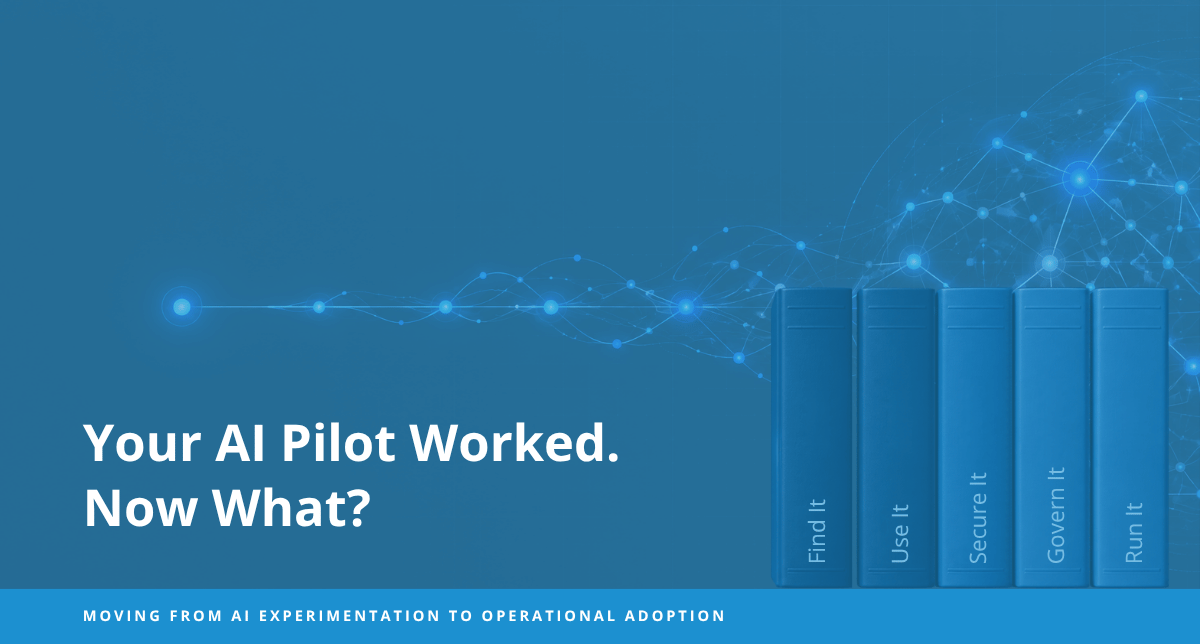
At Varium, we approach this through THE REPERTOIRE, five connected movements that help organizations identify opportunities, build capabilities, protect information, establish governance, and sustain AI operations.
Why promising AI pilots stall
AI experimentation is relatively easy to begin. Employees can test tools, explore use cases, and demonstrate results with limited resources.
Operational adoption requires more coordination.
Ownership is unclear. A pilot may have an enthusiastic champion without an accountable business owner. As priorities shift, decisions about expansion, performance, and risk remain unresolved.
The workflow isn’t established. A successful demonstration may depend on carefully selected examples or the knowledge of one experienced employee. Without a repeatable process, consistent results become difficult to achieve.
Data security questions remain unanswered. Employees may experiment with sensitive information before the organization has established which tools, data types, and integrations are approved.
Business value hasn’t been measured. Positive feedback provides useful insight, but leadership also needs evidence of time saved, quality improved, costs reduced, or other meaningful outcomes.
Ongoing support is missing. AI tools, organizational needs, and regulatory expectations change. Without someone responsible for monitoring performance, updating policies, and supporting users, adoption becomes difficult to sustain.
These are solvable challenges. Addressing them requires a coordinated approach across business strategy, people, technology, and governance.
Five movements from experimentation to adoption
Varium’s Repertoire brings these capabilities together in a practical progression. Each movement addresses a different part of operational readiness, and organizations can begin wherever their needs are greatest.
1. Find It: Identify where AI belongs.
The first step is understanding where AI can deliver meaningful value and what might prevent successful adoption.
Varium’s Opportunity Assessment evaluates business processes, identifies promising use cases, and helps prioritize investments based on potential impact and feasibility.
Our AI Governance Readiness Assessment examines existing AI use, oversight, policies, and areas of exposure.
Together, these assessments help leadership answer essential questions: Which opportunities deserve investment? What needs to change before deployment? Where should we start?
The outcome: A prioritized roadmap connecting AI opportunities with business value and organizational readiness.
2. Use It: Build skills around real work
Successful adoption depends on employees knowing how to apply AI consistently and appropriately.
Varium’s AI Enablement programs focus on the tools employees already use and the workflows they perform every day. Instructor-led sessions combine practical instruction with hands-on application, helping teams develop repeatable processes they can refine and share.
The objective is to build organizational capability that extends beyond individual early adopters.
The outcome: Employees equipped to use AI confidently, with documented workflows that support consistent execution.
3. Secure It: Protect the information AI touches
As AI becomes part of daily operations, organizations need clear expectations for protecting sensitive information.
Varium combines AI security and data protection education with technical preparation for organizations deploying AI in sensitive or regulated environments.
This may include employee training, review of data pathways, infrastructure hardening, access controls, and documentation of safeguards.
The specific controls depend on the use case, technology, and information involved.
The outcome: Better-informed employees, defined data handling practices, and security controls appropriate to the deployment.
4. Govern It: Establish accountability
Governance provides the structure for making decisions about AI use, managing risk, and demonstrating oversight.
Varium develops AI use policies and governance programs aligned with how organizations actually operate. Depending on the engagement, this includes defined responsibilities, acceptable-use requirements, oversight processes, risk management procedures, and implementation support.
The goal is to make governance understandable, actionable, and sustainable.
The outcome: Documented accountability, practical policies, and a governance structure that supports responsible adoption.
5. Run It: Sustain the program
Deployment is an important milestone. Long-term value depends on what happens afterward.
Varium’s ongoing governance and managed services help organizations maintain policies, monitor emerging risks, support oversight activities, and adjust practices as AI tools and requirements evolve.
For organizations without dedicated internal AI governance resources, managed services provide a way to maintain operational continuity.
The outcome: An AI program with ongoing oversight, support, and a process for continuous improvement.
From pilot to practice: six things that need to change
Moving AI into operations becomes easier when leadership can identify what is missing.
1. Ownership: Assign accountability
Identify a business owner responsible for the workflow, its results, and decisions about ongoing use.
2. Workflow: Make the process repeatable
Document when and how AI is used, who reviews its output, and how the work moves into existing business systems.
3. Data: Establish clear boundaries
Determine which information the AI system may access, what protections are required, and which uses are prohibited.
4. Measurement: Define what success looks like
Establish a baseline and track outcomes such as turnaround time, quality, cost, or employee capacity.
5. Support: Plan for ongoing change
Assign responsibility for user support, performance monitoring, training updates, and policy maintenance.
6. Budget: Fund the operational capability
Account for recurring software, infrastructure, support, governance, and training costs. Identify who owns the budget and how continued investment will be evaluated.
These six elements create a practical operational readiness checklist. They also provide a way to identify which parts of The Repertoire can help close the gaps.
What operational adoption looks like
Consider a hypothetical 260-person professional services firm.
Eight employees on its client onboarding team have spent three months testing an AI assistant that summarizes incoming client agreements. Early feedback is positive, and the team sees potential to reduce administrative work.
Expansion stalls when the compliance lead asks which client information the assistant processed during testing. The team cannot provide a complete answer.
The firm needs a plan before expanding the workflow.
- Through Find It, leadership evaluates the opportunity, reviews existing AI activity, and prioritizes the onboarding use case.
- Through Use It, the team receives practical training and documents a consistent method for preparing, reviewing, and approving summaries.
- Through Secure It, the firm establishes approved data handling procedures and evaluates the technical controls required for its document environment.
- Through Govern It, the organization assigns an accountable owner, defines acceptable use, and documents review requirements.
- Through Run It, the workflow becomes part of an ongoing oversight and support process.
The resulting operating record might look like this:
- Workflow: Client agreement summaries for onboarding
- Accountable owner: Director of Client Onboarding
- Approved data: Authorized agreement content, with personal information handled according to documented policy and approved controls
- Performance measure: First-draft turnaround time, compared against a baseline established before rollout
- Human oversight: Onboarding lead reviews and approves summaries before they enter the client file
- Ongoing support: Periodic review of workflow performance, training, policies, and security controls
- Budget: Assigned operating budget with an annual review
This example is illustrative. The organization, workflow details, and outcomes are hypothetical.
The firm now has a documented process for managing the workflow, evaluating its value, and making decisions about future expansion.
Your next AI initiative deserves an operating plan
An effective AI pilot demonstrates potential. Operational adoption turns that potential into a capability employees can use, leadership can measure, and the organization can manage responsibly.
That requires clear ownership, practical training, appropriate security controls, governance, and ongoing support.
You don’t have to solve every challenge across the organization at once. Start with one promising use case, identify what is preventing broader adoption, and build the foundation to move it forward.
Ready to move beyond AI experimentation?
Varium helps organizations turn promising AI pilots into secure, measurable, and sustainable operations.
Schedule an AI Opportunity & Readiness Conversation with Varium. We’ll discuss where your AI initiatives stand, what’s holding them back, and the most practical next step toward operational adoption.
Comments are closed